Doug Childers/Homes Correspondent
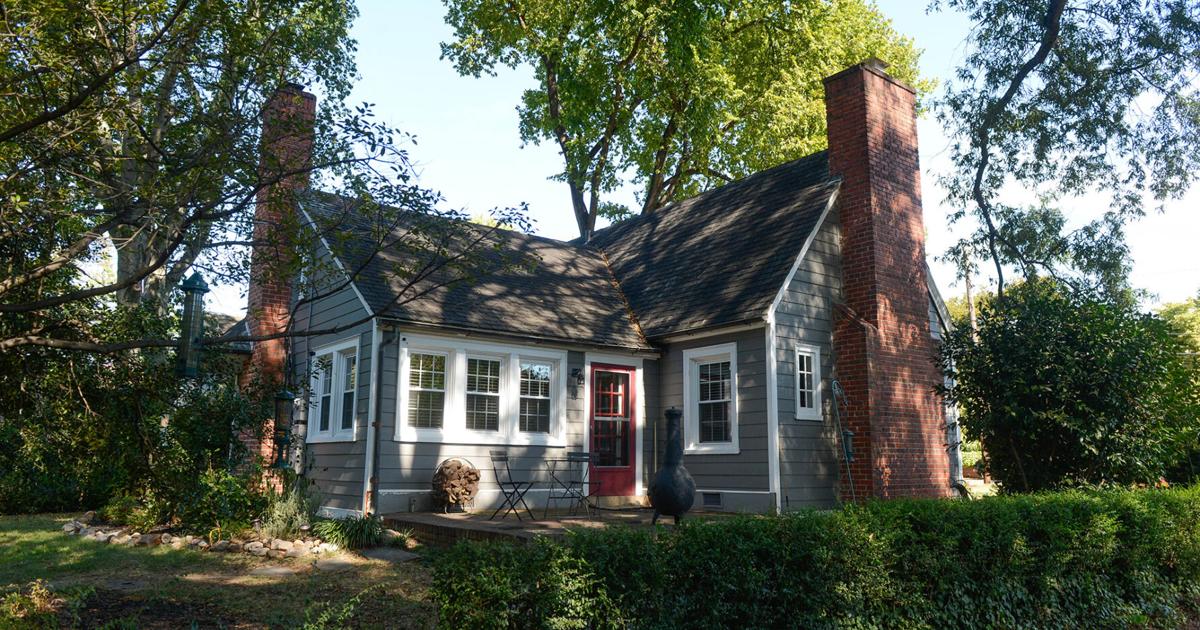
If you've driven down Bute Lane in Richmond's Carillon neighborhood, you might not have noticed the pair of quaint Cotswold-style cottages near its eastern terminus. Odds are you were probably distracted by Marburg, a 19th century Victorian home that sits across the street from the cottages.
If you were walking, it might be a different story. It certainly was for Peter and Megan Fries.
"Peter and I are big walkers, and every time we passed the cottages, we'd say, 'They're so cute,'" Megan Fries said. At that point, the couple merely appreciated the cottages' aesthetics. When the one at 3113 Bute Lane came on the market two years ago, though, it got serious.
"We weren't even planning on selling our house, but Peter went to see it and called me to say, 'You've got to come over,'" Fries said. "It was love at first sight."
That's when they discovered the cottages' impressive pedigrees. They had been designed by W. Duncan Lee, a prominent Richmond architect of the early 20th century.
Lee's lofty reputation rests on his large, Colonial Revival-style homes, including several on Monument Avenue. But while that style – with its white-columned porches and symmetrical red-brick façades – may have dominated Richmond's architectural landscape, Lee also designed homes in what might be called a vernacular cottage style with a European focus.
He even called his own aggressively unornamented, stucco-clad home at 12 Stonehurst Green his "Irish cottage." Lee built his house in 1926, two years after the Bute Lane cottages were finished.
Like Lee's design for his own house, the Bute Lane cottages "have simple asymmetrical massing and exhibit vague Cotswold features such as steeply pitched gables and prominent chimneys," said Elizabeth O'Leary, former associate curator of American art for the Virginia Museum of Fine Arts and a Carillon resident who has done extensive research on the neighborhood.
While the cottage at 3109 Bute Lane is stucco-clad, the one at 3113 has wood siding. Each has approximately 1,100 square feet of living space – relatively modest compared to the contemporaneous revival-style mansions built nearby as part of the William Byrd Parkway development.
"While diminutive in size, the cottages were meticulously built and outfitted with fine Arts and Crafts detailing, including built-in cupboards, shelves and hidden closets, as well as hand-wrought iron hardware and light fixtures," O'Leary said. "Inside and out, they exude a 'storybook' quality."
The Frieses were won over by the well-preserved charm of the cottage at 3113 Bute Lane, and they bought it in February 2020. And that's when they learned another local-history nugget. Or maybe it was more like local gossip.
"For close to a century, the neighborhood perpetuated the tale of the so-called Love Cottages as having been built as an illicit getaway for a Richmond businessman and his lady friend," O'Leary said. "Speculation transformed the long-vanished Charles F. Gillette garden that once stood between the houses into the proverbial 'primrose path.'"
It's a great story as gossip goes, but O'Leary recently debunked it when she found a 1925 print ad that dubbed the cottages collectively as the Love Nest. The fact that it ran before either property sold "dampens the myth," O'Leary said. "However, the nickname gives evidence of their creators' playful Roaring Twenties imagination."
Even shorn of their risqué origin myth, the cottages have great appeal. And they seem to be adept at snaring buyers who had no plans to purchase a home.
India Swenson-Waring, who bought the cottage at 3109 Bute Lane in 2000, was simply shopping for a rug at an estate sale being held at the cottage. Then she learned the cottage owners were accepting private bids for the property. A family friend in the real estate business helped Swenson-Waring develop a strategy for bidding – and it worked.
"I won the bid on the log cabin rug, and my offer for 3109 was accepted, all because of a serendipitous estate sale, a lot of luck and a little bit of fate," Swenson-Waring said.
Don't expect to hear the cottages' siren call soon, though.
"They rarely come on the market," said Susan Fisher, an associate broker with Virginia Properties, Long & Foster and a Carillon resident.
Swenson-Waring bought her cottage from a family that had lived there for 45 years. And the Frieses bought theirs from a family who had lived there at least 30 years.
The reason for the low turnover is simple, Fisher said: "The cottages are absolute gems."



Comments
Post a Comment